
James Quinn Wilson là một học giả và là nhà chính trị xã hội . Lý thuyết về “
the broken windows “ có ảnh hưởng lớn đến nhiều thay đổi trong hệ thống trị an Hoa Kỳ.
Nghe Audio :
Listen
From Wikipedia:
James Quinn Wilson (May 27, 1931 – March 2, 2012) was an American academic, political scientist, and an authority on public administration. A Ronald Reagan Professor of Public Policy at Pepperdine University and a senior fellow at the Clough Center for the Study of Constitutional Democracy at Boston College, he was a co-author of the 1982 article introducing
the broken windows theory.
SCRIPT:
Welcome to This Is America with VOA Learning English.
Today, we are talking about political and social scientist James Q. Wilson. Wilson was interested in a great many subjects. But he was best known for his research into the behavior of criminals and police. He helped change the way policing is done is America.
Wilson died in March 2012 at the age of eighty. He had been receiving treatment for leukemia.

James Q. Wilson in 1972
This week on our program Bob Doughty and Faith Lapidus look back at Wilson’s influence on modern policing. They also look at some of the ways technology is leading law enforcement into the future.
In March 1982, the Atlantic magazine published an article that described a theory of community policing. That theory would come to influence a new direction in American law enforcement.
James Q. Wilson wrote the article with criminologist George Kelling. Crime and disorder in a community are usually linked, they said, and they used an example. "Social psychologists and police officers tend to agree that if a window in a building is broken and is left unrepaired, all the rest of the windows will soon be broken. This is as true in nice neighborhoods as in rundown ones," they wrote.
Broken Windows Lead To...
The idea was that keeping order in a community and fighting low-level crime can lead to a reduction in more serious crimes. The article was called "Broken Windows: The Police and Neighborhood Safety." The theory came to be known as the "broken windows" theory.
The ideas the authors presented were largely based on psychology and how people form opinions about the safety of a neighborhood. Their research showed that people base their opinions less on the actual crime rate and more on whether the area appears safe and orderly.
They said "one unrepaired broken window is a signal that no one cares." If a window is broken and then quickly fixed, it sends a message that people care enough to keep order in the neighborhood.
The link that the two researchers made between disorder and crime is indirect. Disorder leads to citizen fear, which leads to weakened social controls. And those weakened controls create conditions where crimes are more likely to occur.
The solution, the authors said, was a kind of community policing centered on preventing crimes rather than just reacting to them.
The broken windows theory represented a very different way to look at policing methods at a time when, in many cities, crime seemed out of control.
The Crack Wars Begin; Crimes Rates Rise
John DeCarlo is a professor of criminal justice at the University of New Haven in Connecticut. He says crime rates in the United States rose sharply from the 1960s to the middle of the 1990s.
"We had seen crime rates during the 80s that the country had literally never seen before. The violent crime rate and the property crime rate were exceptionally high. Criminologists across the United States had pretty much given up hope that police could have any effect on crime."
That crime wave included the so-called crack wars, the violent competition between drug dealers in the rise of crack cocaine.
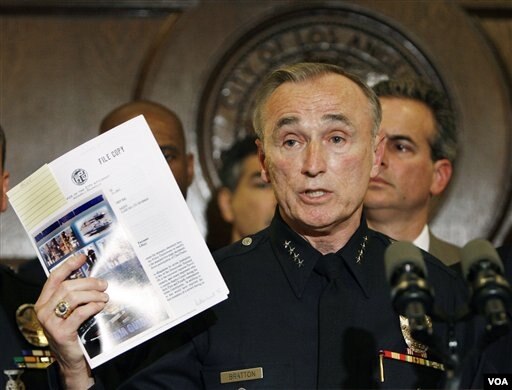
In the 1990s, the mayor of New York, Rudolph Giuliani, began a crime reduction program in the city. His first police commissioner, William Bratton, used ideas similar to what James Q. Wilson had been writing about. These included putting more police officers on foot instead of in cars. More attention went into targeting low-level criminals and keeping order in neighborhoods.

Chief William Bratton
Professor DeCarlo says this was the beginning of a new way of operating within a police force.
"When Bratton came into New York he concentrated on low-level criminals rather than higher-level criminals, thinking that taking care of the low level criminals would automatically take care of the higher-level criminals because, indeed, they were the same people."
In 1990, New York had more than 2000 killings. That same year, William Bratton arrived as chief of the city's transit police. One of the things he did, says Professor DeCarlo, was to send more police officers into the subway system to arrest people for turnstile jumping. That is jumping over the fare gates without paying for a train ride.
"What happened was they started arresting people for the low-level crime of turnstile jumping, and what happened is they diminished the number of violent criminals because indeed they were the same people. As they started arresting that segment of the population, crime started coming down."
Turnstile jumpers were sometimes found carrying guns or knives. So arresting them prevented more serious crimes, Mr. Bratton would say. He served as transit police chief from 1990 to 1991. He left to lead the Boston police. But he returned three years later to become commissioner of the New York Police Department.
By 1998 - two years after he left that job - America's largest city had just 629 homicides. Mr. Bratton has credited his success in reducing crime rates to the methods he based on James Q. Wilson’s ideas of community policing.
William Bratton went on to serve as police chief in Los Angeles, where crime also fell sharply.
"Community Policing" Begins to Spread
The idea of community policing - of trying to work with the community being policed - has spread throughout the country.
Finding a balance is not always easy. If policing is seen as overly aggressive, it can deepen mistrust. Police may find more weapons by searching more people on the street. But they need a legal reason to stop someone. If not, they could be accused of violating a person's rights, or racial profiling— targeting people just because of their race.
Criminal justice professor John DeCarlo says paying attention to low-level crimes can mean different things in different communities. For example, police may focus on traffic violations like speeding. This may not only reduce accidents and improve the quality of life in a community. It also gives the police a chance to check the records and see if a speeder is wanted for more serious crimes.
Using Technology to Fight Crimes
Another change in policing that began in New York in the 1990s is greater use of information technology. CompStat is a name for the idea of using computers to map daily reports of crime and disorder in individual neighborhoods. Professor DeCarlo says this CompStat information can help police know where to target enforcement efforts and resources.
“It’s a policing management strategy. CompStat is about holding policemen accountable for the areas they work in."
CompStat has critics. They say officers and supervisors who feel pressure to show improvements may be tempted to think of dishonest ways to do it. There have been some cases like this. But experts say the use of CompStat is widely accepted as having revolutionized crime fighting.
James Q. Wilson was born in Denver, Colorado, in 1931. He earned advanced degrees in political science at the University of Chicago. Over his long career, he was a professor at Harvard University, the University of California, Los Angeles, and Pepperdine University.
His books ranged from "Negro Politics: The Search for Leadership," published in 1960, to "The Marriage Problem: How Our Culture Has Weakened Families." That book came out in 2002. He served on a number of national and presidential commissions. And in 2003 President George W. Bush awarded him the Presidential Medal of Freedom.
Policing methods continue to evolve and change. New technology continues to be one of the biggest trends in law enforcement.
The Power of "Crime Mapping"
Tod Burke is a professor of criminal justice at Radford University in Virginia. He says improved crime mapping is a big help for police.
"This is taking police officers and placing them in the area where they’re really needed. This becomes critical particularly as resources and finances are problematic in many law enforcement departments across the United States, and probably throughout the world."

A U.S. Secret Service police car passes by the Syrian Embassy in Washington
A U.S. Secret Service police car passes by the Syrian Embassy in Washington
There are thousands of law enforcement agencies at the local, state and national level in the United States. Today improved CompStat systems are helping to connect departments across the country to share information.
Smile! You're on Camera
Surveillance cameras are a method of policing widely used in Britain. Cameras are also increasingly used by police in the United States. The trend has spread, especially in busy areas and areas with large populations, like New York.
Computer programs can recognize faces, watch for signs of trouble and attempt to locate gunshots.
In some law enforcement agencies, officers even wear small video cameras. The recordings may help settle any questions about the behavior of officers or the people they deal with.
The use of video cameras can raise privacy concerns, but Professor Burke points out that these days almost everyone has one.
"Let's face it, many people have video cameras themselves, many attached to their phones. And that is also aiding in law enforcement efforts — what I call video vigilantes. Everything is being videotaped, and much of it is going onto social networks such as YouTube and Facebook.
But officers worry that some people are just looking for a chance to try to make the police look bad while doing a dangerous job.
Officials are concerned about an increase in the killing of law enforcement officers in the United States, even as crime rates have dropped.
This program was written and produced by Brianna Blake.
Bob Doughty and Faith Lapidus were your presenters.
Download các Audio khác:
http://www.fileduty.com/download/510/se-itn-chen-guangcheng-5may12.Mp3

 5:10 AM
 Tieng Anh Vui




 Posts
Posts

